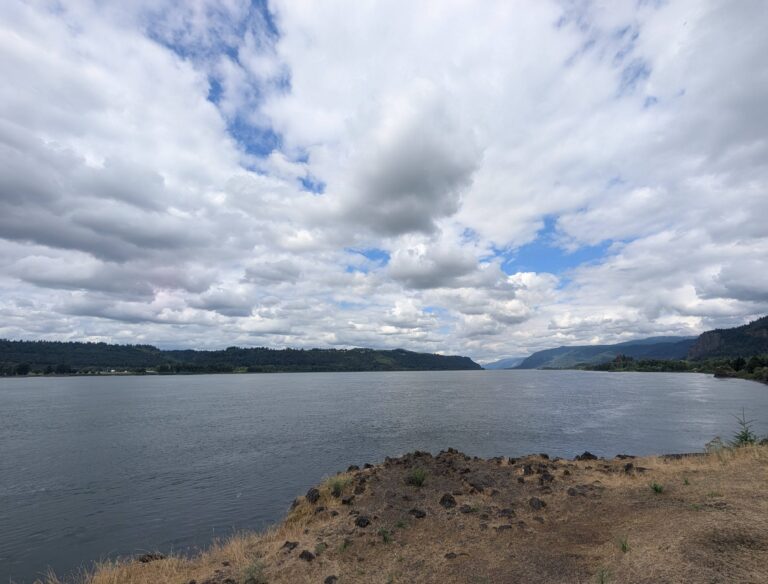
I am holding the future. I hold space for the future in which the Salish Sea sovereign ecosystem is vibrant and thriving. Many beings shelter in this ecosystem: pine and cedar and maple, eagle and raven and loon, deer and bear and wolf, salmon and orca and otter, all the beings that grow fly and walk and swim. Humans are held here too, humans who recognize the trees and creatures as our relatives, respect their rights and needs as living beings, and listen to them as our teachers.
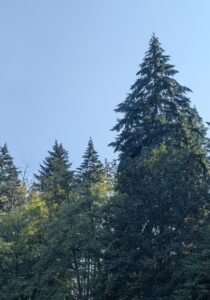
I breathe the clear air of this place. I savor the clear water of this place. I imagine this place while I am standing beside a Douglas fir in my back yard. This indigenous fir has stood in these woods since the time before settler contact. This tree is clearly a mother tree supporting many other smaller trees in the same forest. This tree is important (all trees are important) because it is not a theoretical tree, it is an actual tree which lives where I live. It is the tree to which I belong.
This tree is a survivor in a forest which continues to be destroyed. The forest ridge one street over from mine was wiped slick of every living thing to build a housing complex. All the creatures that lived in those woods moved over to mine, including the eagles and ravens and deer, and the beetle that now marks the bark of my mother tree with frass. This Douglas fir, this mother tree, this survivor tree stands in air that today is thick with the smoke of burned trees as forest fires rage in the Pacific Northwest.
I stand beside this living tree breathing the smoke of burning trees and I am simultaneously hurt and nourished. I am hurt because I am breathing the smoke of dying trees. I am hurt because I register the beetle damage to the mother tree as an existential threat. I belong to this tree and the tree is under attack. The developers didn’t cut this tree but they did affect it. I went to my county commissioner and explained this, and she actually understood this. She told me that the commissioners have passed new regulations that entire ridges of trees can no longer be cleared, there must be trees left. They call it canopy preservation.
This is helpful. I’m glad I took action to protect the tree to which I belong and I’m glad that there has been a tiny little bit of legal progress. I can’t help but think this is not nearly enough. As long as we still think about trees as property, as resources, as long as they have no rights we’re still going to rip up living ecosystems as if that doesn’t also rip up ourselves.
The people who came before me in this place have another way to think about it. The Suquamish have lived along these waterways for time immemorial. The tribe’s web site offers this story about the world:
In the very beginning, there was a wonderful world here long before human beings arrived. It was a world where everything had the power and ability to take any form or do anything. A world inhabited by beings who might appear as animals, plants, in human or inhuman form, or as aspects of the landscape, always shimmering between these and other shapes. Finally, a firm order was imposed on this world by The Changer, enabling human beings to take their place in the world.
As a result, the beings have been changed into the shapes of trees, plants, animals, fish, rocks, springs, and so forth, while their spirits retain their original abilities. In these forms, they have retained their full intelligence and emotions, and many have entered into partnership with particular individuals to grant them abilities and careers.
The first time I read the story I thought it was fanciful. Metaphorical. The trees are conscious metaphorically. Science is beginning to recognize that trees communicate with each other and support each other, but calling them conscious, like people? That’s a hard sell.
Then I heard Tribal Chairman Leonard Forsman tell that story live. In June 2026 he gave a lecture for the University of Washington Continuum College titled “Living Through Time: The Suquamish People & the Salish Sea”. He started the lecture by talking about The Changer and how the living beings changed into springs and animals and trees.
Tribal Chairman Leonard Forsman told that story as the first thing and most important thing to say about Suquamish history and the Salish Sea. It started to sink in to me in that the story is seriously saying that trees are conscious, have feelings, support other living beings. It’s not a metaphor that I belong to the mother tree, it is a lived reality. And I can’t help but think that if this was the dominant paradigm, cut all the trees and build something else wouldn’t be the default setting for our relationship with the forest.
I stand beside this living tree breathing the smoke of burning trees and I am simultaneously hurt and nourished. I am nourished because I belong to the tree and the tree is alive, supporting all the other little trees around, supporting the eagles and ravens and cooper’s hawks, supporting me. I am so incredibly and deeply comforted and sustained by this massive being that dwarfs my body in size and my life in years and my consciousness in connection with everything that is.
This tree lived here before I came. It’s my responsibility to hold the space for this tree to live here after I am gone. Not just to legally transfer title to someone who will preserve the woods and not cut them, although that’s a minimum requirement. I must also hold space for a future which includes the continued life of this tree for another half millennium. This means envisioning a future. Where does this vision come from?
I already have the answer, it comes from the past. It comes from the indigenous people of this place. Indigenous people all over the country and all over the world share this knowledge, the knowledge of what it was like before. What the sovereign ecosystem was like when it was vibrant and thriving. I’m collecting stories, I read a new one every day, where indigenous people get authority over the land and immediately start to restore it, because they know what it was like before. The land is returned to them and they return the land to itself.
A Nishnaabeg woman puts this very clearly. In As We have Always Done Leanne Betasamasoke Simpson describes how she navigates through the intense destruction of her homelands to a vision of the future she wants for her children:
I began to start my own talks with a narrative of what our land used to look like as a quick glimpse, albeit a generalized one, of what was lost – not as a mourning of loss but as a way of living in an Nishnaabeg present that collapses both the past and the future and as a way of positioning myself in relation to my Ancestors and my relations.
My vision of the future in which the Salish Sea sovereign ecosystem is vibrant and thriving is also the past in which the Salish Sea sovereign ecosystem was vibrant and thriving. I imagine this place by remembering this place. I remember the trees that stood on the ridge. I listen to the beings who came before me in this place, the indigenous people and the Douglas fir mother tree survivor I am standing beside.
Navigating the present destruction to the hope of the future means restoring the past. The past had a shape, a pattern that was disrupted. I restore the past by affirming the pattern. This affirmation has a physical component, I make sure the person who inherits the tree will respect and preserve it. This affirmation has a legal component, I talk to my county commissioner about canopy preservation, and I use the term sovereign ecosystem as a marker for a desperately needed shift in our values. This affirmation has a spiritual component, I don’t think about myself as owning the tree, I think about the tree as a sovereign conscious being which owns me.
This is how I am holding the future as I stand beside the tree.